
My Chino Home Is Paid Off. Should I Stay or Consider Downsizing?
You spent 30 years paying off your house. But here's a question most homeowners never think to ask: Is that same house still working for you?
Maybe you bought your home in Chino or Chino Hills 25 or 30 years ago.
You raised your children there. You celebrated birthdays, hosted holidays, watched your kids grow up, and created memories that no amount of money could replace.
Then one day, you made your final mortgage payment.
Your house was officially paid off.
That's a tremendous accomplishment.
But now life looks a little different.
The kids have moved out. Some bedrooms haven't been used in years. The backyard requires more work than it used to. Maybe you're approaching retirement, or you've started thinking about moving closer to your children and grandchildren.
And suddenly, a question comes up:
"If our house is paid off, why would we ever consider selling it?"
It's a great question. And the answer might surprise you.
Because sometimes the house that was perfect for raising your family isn't necessarily the house that makes the most sense for your next chapter.
1. Your Mortgage Is Gone. But the Cost of Owning Your Home Isn't.
One of the biggest misconceptions about owning a paid-off home is believing that housing expenses have disappeared.
Yes, you've eliminated your mortgage's principal and interest payments.
But you haven't eliminated the cost of owning the property.
Think about what you still pay for every year:
-
Property taxes: Even with California's Proposition 13 protections, property taxes and applicable assessments continue.
-
Homeowners insurance: Premiums and coverage costs can change over time.
-
Utilities: Electricity, gas, water, and other services still need to be paid.
-
Landscaping: Maintaining a large yard, trees, or swimming pool can become expensive.
-
Routine maintenance: Every property requires ongoing attention.
-
Major repairs: Roofs, HVAC systems, water heaters, plumbing, electrical panels, and appliances eventually need attention or replacement.
And here's something we encourage longtime homeowners to think about:
It's not just what your home costs you financially. It's also what your home requires from you physically and emotionally.
Your weekends matter.
Your time matters.
And how you want to spend your retirement matters.
2. What Does Your Paid-Off House Really Cost You Every Month?
Here's a simple exercise.
Imagine your home is completely paid off, but your annual ownership expenses look like this:
| Expense | Annual Cost |
|---|---|
| Property taxes | $5,000 |
| Homeowners insurance | $2,500 |
| Utilities | $4,000 |
| Landscaping and upkeep | $2,500 |
| Maintenance and repair reserve | $4,000 |
| Total | $18,000 |
That's $1,500 per month, even without a mortgage.
These are hypothetical numbers for illustration, not actual costs for a particular Chino or Chino Hills property.
Now ask yourself:
Could a smaller home reduce those expenses?
Possibly.
But here's where homeowners need to be careful.
A smaller house doesn't automatically mean lower expenses.
If you purchase another property, your taxes, insurance, HOA fees, or financing costs could be higher than what you're paying today.
In fact, this is something we've explored in another article: Downsizing in Chino or Chino Hills: What If the Smaller Home Costs Almost as Much?.
The goal isn't simply to move into a smaller house. The goal is to understand whether moving would improve your overall financial situation and quality of life.
3. You May Be Sitting on More Home Equity Than You Realize
If you've owned your home in Chino, Chino Hills, or the surrounding Inland Empire for several decades, you may have accumulated substantial equity.
And if your mortgage is paid off, that equity may represent one of your largest financial assets.
But here's something important:
Having a million-dollar home doesn't necessarily mean having a million dollars available to spend.
Your equity is tied to your property until you access it through a sale or another financial arrangement.
For some homeowners, selling creates an opportunity to purchase a smaller property, move closer to family, or reduce the responsibilities that come with maintaining a larger home.
For others, keeping their current home is the better financial decision.
Before choosing either direction, we believe homeowners should understand three numbers:
-
What could your home realistically sell for today?
-
How much would you actually walk away with after selling expenses and potential taxes?
-
What would your next home cost to purchase and maintain?
Those three numbers can completely change how you look at your options.
And here's something else to consider.
If you've owned your property for 25 or 30 years, you may not realize how much its value has changed.
A home you originally purchased for $200,000 or $300,000 could potentially be worth substantially more today, depending on its location, condition, and market.
But the only way to understand your situation is to evaluate your specific property.
Your home's equity should be part of your retirement conversation, even if you ultimately decide never to sell.
4. The Five-Bedroom House That Once Made Perfect Sense
Think back to when you first purchased your family home.
You needed bedrooms for the kids.
You wanted a backyard where everyone could play.
You needed room for family gatherings, school projects, birthday parties, and maybe even a home office.
Every square foot had a purpose.
Fast-forward 25 or 30 years.
The kids are grown.
Maybe two bedrooms are now storage rooms.
The upstairs hardly gets used.
The pool needs cleaning.
The landscaping needs attention.
And that big house you once needed may now feel like more responsibility than you want.
Here's the question worth asking:
Are you keeping the house because it still fits your life, or because it's the house you've always known?
There's no wrong answer.
Some homeowners genuinely love their homes and never want to leave.
Others realize that what they really want isn't necessarily a bigger house or a more expensive house.
It's a simpler life.
Maybe that means a single-story home.
Maybe it means a smaller backyard.
Maybe it means less maintenance and more time traveling.
And sometimes, it means living closer to the people who matter most.
5. What If Your Next Chapter Is About Family, Not Real Estate?
We talk to homeowners who aren't necessarily thinking about selling because of mortgage rates or home prices.
They're thinking about selling because life has changed.
Maybe your daughter moved to Arizona.
Your son lives in Texas.
Your grandchildren are growing up in Nevada.
And you're tired of only seeing them a few times a year.
You want to attend the school plays.
You want to celebrate birthdays without booking a flight.
You want to be part of their everyday lives.
Or perhaps you're thinking about moving closer to aging parents who need your help.
Sometimes moving isn't about the real estate market. It's about being closer to the people you love.
We've explored this emotional decision in another article: Your Kids and Grandchildren Moved Out of California: Should You Sell Your Chino or Chino Hills Home and Move Closer to Them?.
It's a conversation worth having because the decision to move closer to family often involves more than money.
It involves time.
Relationships.
And deciding how you want to spend the years ahead.
That's why we believe the conversation about downsizing should begin with your lifestyle and your goals—not simply with the current price of your home.
6. California Homeowners Over 55: Don't Overlook Proposition 19
One concern we frequently hear from longtime California homeowners is:
"If I sell my house, am I going to lose my low property taxes?"
That's an important question, especially for homeowners who purchased their properties decades ago.
California's Proposition 19 may provide an opportunity for qualifying homeowners age 55 or older to transfer their existing property's taxable base-year value to a replacement primary residence anywhere in California.
Here's what homeowners should know:
-
The original and replacement properties must meet qualifying primary-residence requirements.
-
The replacement property must generally be purchased or newly constructed within two years before or after the sale of the original home.
-
Eligible homeowners age 55 or older may use the benefit up to three times.
-
A replacement home with a higher market value may still qualify, although the transferred taxable value may be adjusted.
-
A claim must be filed with the county assessor where the replacement property is located.
This could make a meaningful difference when comparing the cost of staying with the cost of purchasing another home.
For a deeper explanation, read our article: What Is Proposition 19 in California? A Guide for Homeowners 55+ and Families Inheriting a Home.
But remember, Proposition 19 isn't automatic, and it doesn't mean your property taxes will necessarily remain exactly the same.
Before making a decision, consult the appropriate county assessor and a qualified tax professional.
Important: Proposition 19's California property-tax transfer benefit generally does not follow you when purchasing a replacement home outside California.
7. What About Capital Gains Taxes When Selling a Paid-Off Home?
This is another important part of the conversation.
Just because your home is paid off doesn't mean the entire sale price is tax-free.
For qualifying homeowners, federal tax rules may allow an exclusion of up to $250,000 in gain for an individual or up to $500,000 for married couples filing jointly when selling a primary residence, subject to ownership, use, and other requirements.
But the exclusion applies to eligible capital gains—not simply the amount of money you receive at closing.
Your original purchase price, qualifying improvements, selling expenses, and other tax considerations can affect the calculation.
If you've owned your property for decades and its value has increased significantly, this is something worth discussing with your CPA before listing your home.
A smart downsizing plan considers your after-tax proceeds, not just your home's estimated selling price.
8. Should You Renovate Your Chino Home Before Selling?
Here's another situation we see with longtime homeowners.
They've lived in their house for 20 or 30 years.
The property has been well loved, but maybe the kitchen is outdated, the flooring needs replacement, or the bathrooms haven't been remodeled.
And they assume they'll need to spend $50,000 or $100,000 before selling.
Not necessarily.
Before investing significant money, we recommend evaluating three strategies.
Option 1: Sell the Home As-Is
Depending on the property's condition, pricing, buyer demand, and required disclosures, selling in its current condition may be a practical option.
Option 2: Make Strategic Improvements
Sometimes cleaning, painting, landscaping, decluttering, or addressing a few important repairs can make a meaningful difference in how buyers respond.
Option 3: Complete Larger Renovations
In some situations, significant renovations may make sense. But homeowners should compare the expected increase in sale proceeds against the cost, time, and risk of completing the work.
The biggest mistake is spending money on improvements before knowing whether buyers will actually pay enough more to justify them.
Every property is different.
The strategy for a well-maintained single-story home in Chino may be very different from the strategy for a larger two-story property in Chino Hills that needs extensive updating.
That's why a property-specific evaluation matters.
9. What Is Happening in the Chino and Chino Hills Housing Markets?
If you're considering downsizing, understanding your local market is an important part of the decision.
But here's something we want homeowners to understand.
The market for your particular house may be very different from the overall market in your city.
Chino and Chino Hills are neighboring communities, but buyers aren't necessarily looking for the same type of property in both cities.
A single-story home with a manageable backyard may appeal to a completely different buyer than a large two-story property with five bedrooms and a swimming pool.
And the condition of your home matters.
Buyers may respond differently to a move-in-ready property than they would to a home needing a new roof, HVAC system, or extensive cosmetic updates.
That's why citywide median prices and market statistics only tell part of the story.
Before deciding whether to sell, homeowners should understand:
-
How many similar properties are currently competing with theirs.
-
What comparable homes have actually sold for.
-
How long those properties took to sell.
-
Whether buyers are negotiating repairs, credits, or price reductions.
-
What improvements, if any, could help the home compete.
The goal isn't to guess what your home might be worth. It's to understand what today's buyers are actually willing to pay for a property like yours.
And that requires a local, property-specific strategy.
10. What If Your Aging Parents Can No Longer Maintain Their Home?
Sometimes the downsizing conversation doesn't begin with the homeowner.
It begins with their adult children.
Maybe Mom and Dad have lived in the same Chino home for 35 years.
The mortgage is paid off.
They love the neighborhood.
But maintaining the property has become difficult.
Maybe the stairs are a concern.
Maybe one parent has passed away.
Or perhaps the family is starting to discuss whether living alone is still practical.
These conversations can be emotional.
And they often involve several family members with different opinions.
The biggest mistake families can make is waiting until an emergency forces everyone to make a decision quickly.
Planning ahead creates options.
That might mean making accessibility improvements so Mom or Dad can remain in the home.
It might mean relocating closer to family.
Or it might mean selling and transitioning into a property that better fits their needs.
We discuss this situation in greater detail in Mom or Dad Can't Stay in Their Chino Home Anymore: What Happens Next?.
The important thing is approaching the conversation with patience, planning, and a clear understanding of the family's options.
11. Five Questions to Ask Before Deciding to Stay or Downsize
Before making a decision, sit down and ask yourself these five questions.
1. If I were buying a home today, would I choose this same house?
Think about the size, layout, stairs, maintenance, and location.
2. What does it really cost me to keep this property?
Look beyond the mortgage payment and calculate your full annual ownership expenses.
3. What would I actually receive if I sold?
Consider the likely sale price, transaction expenses, potential taxes, and net proceeds.
4. Where would I want to live next?
Would you stay in Chino or Chino Hills? Move to a smaller home in the Inland Empire? Relocate to Orange County? Or move out of state to be closer to family?
5. What would make my next 10 or 20 years better?
Less maintenance?
More financial flexibility?
A single-story floor plan?
More time with family?
Or simply the peace of mind that comes from staying exactly where you are?
The answers may help you determine which direction makes the most sense.
12. What If Staying in Your Paid-Off Home Is the Best Decision?
We want to make something very clear.
Not every homeowner who has paid off their mortgage should sell.
In fact, for some homeowners, staying is absolutely the right decision.
Maybe your home is comfortable.
Your expenses are manageable.
You love your neighbors.
Your family lives nearby.
And you have no desire to move.
That's perfectly reasonable.
You might decide to make accessibility improvements, update aging systems, create a maintenance reserve, or prepare a longer-term housing plan instead.
The goal shouldn't be to sell simply because you've reached retirement age.
The goal should be to make sure your housing situation continues to support the life you want.
And sometimes, that means staying right where you are.
Frequently Asked Questions About Downsizing in Chino and Chino Hills
Should I sell my Chino home if it's completely paid off?
Not necessarily. A paid-off home can provide financial stability. Compare your ongoing expenses, home equity, lifestyle needs, and replacement-home costs before making a decision.
Is it financially smart to downsize after retirement?
It can be, especially when downsizing reduces maintenance responsibilities or overall expenses. However, higher property taxes, HOA dues, insurance, or financing costs may offset potential savings.
Can I keep my low California property taxes if I move after age 55?
Qualifying homeowners may be eligible to transfer their property's taxable base-year value under Proposition 19 when purchasing a replacement primary residence in California. Eligibility and timing requirements apply.
Do I need to remodel my house before selling in Chino or Chino Hills?
Not always. The best approach depends on the home's condition, local buyer expectations, competition, and the expected return on improvements.
Can I sell my paid-off home and buy another house with cash?
Potentially. It depends on your net sale proceeds, the price of the replacement property, and other financial obligations. A detailed net-proceeds estimate can help you evaluate this option.
When should I start planning to downsize?
Ideally, before you feel pressured to move. Starting early gives you time to evaluate repairs, taxes, housing alternatives, and the logistics of your next move.
Is a single-story home better for retirement?
For some homeowners, a single-story floor plan can make daily living easier and reduce concerns about stairs. But the right choice depends on your mobility, preferences, budget, and long-term needs.
Final Thoughts: You Worked Hard for Your Home. Now Make Sure It Works for You.
Paying off your mortgage is a milestone worth celebrating.
For many homeowners, it represents decades of hard work, discipline, sacrifice, and commitment to their families.
And that accomplishment deserves respect.
But here's something we want you to remember:
You don't have to stay in a house forever simply because you worked so hard to pay it off.
And you don't have to sell it simply because you're getting older.
Maybe your next chapter means staying in the home you love.
Maybe it means downsizing into a single-story house with less maintenance.
Maybe it means moving closer to your children and grandchildren.
Or maybe you're simply beginning to explore what retirement could look like.
Whatever the answer, the decision should begin with understanding your options.
Because the best real estate decision isn't always about getting the highest price or timing the market perfectly. It's about making the decision that best supports your life.
Thinking About Downsizing in Chino or Chino Hills? Let's Start With a Conversation.
We're Leticia and Alberto Sotomayor, a husband-and-wife real estate team helping homeowners throughout Chino, Chino Hills, the Inland Empire, and Orange County.
We understand that selling a home you've owned for 20 or 30 years isn't just another real estate transaction.
It's a major life decision.
Before you make that decision, we can help you understand:
-
What your home could realistically sell for in today's market.
-
What your estimated net proceeds may look like.
-
Whether making improvements before selling makes financial sense.
-
What your next housing options might be.
-
How to create a plan that works with your timeline and goals.
No pressure to sell. Just a clear understanding of your options.
Our job is to organize the decisions, reduce uncertainty, and help families move forward.
This article is for general educational purposes and is not intended as financial, legal, or tax advice. Consult qualified professionals regarding your individual circumstances.
FROM OUR BLOG


Waiting Until Spring 2027 to Sell Your Chino Home? Start Preparing Now
Thinking About Selling Your Chino Home in Spring 2027? Start Preparing Now If you are waiting until spring 2027 to sell your Chino or Chino Hills home, you may be making a smart timing decision. But waiting to list and waiting to prepare are two very different things. A homeowner can spend months de
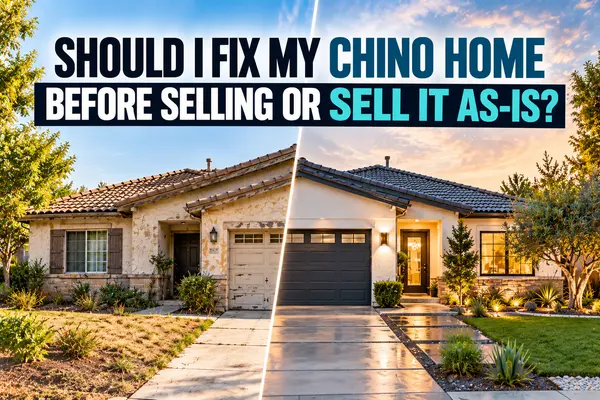
Should I Fix My Chino Home Before Selling or Sell It As-Is?
Should I Fix My Chino Home Before Selling or Sell It As-Is? Your Chino home needs a new roof, the kitchen hasn’t been updated in 25 years, and the flooring has seen better days. Do you really need to spend $50,000 before you can sell? Maybe you’re retiring. Maybe you’re downsizing from a two-story h

Already Bought Your Next House? What to Do if Your Chino Home Hasn’t Sold
Already Bought Your Next House? What to Do if Your Chino Home Hasn’t Sold You bought your next house. You have the keys. You're ready to move forward. But there's one problem: Your old house hasn't sold, and now you're paying for two homes. Two mortgages. Two insurance policies. Two sets of utilitie