
Living Alone in Your Chino or Chino Hills Home After Losing a Spouse—Should You Stay or Downsize?
For many longtime homeowners in Chino and Chino Hills, a house is much more than real estate.
It's where you raised your children.
Where birthdays were celebrated.
Where holidays happened.
Where friends gathered.
Where grandchildren learned which cabinet held the snacks.
Where you sat together at the kitchen table.
Where you drank coffee in the morning.
Where you talked about your plans for retirement.
And most importantly, it may be where you spent 20, 30, 40 or even 50 years building a life with your husband or wife.
Then you lose your spouse.
Suddenly, the house feels different.
The mortgage may be the same.
The property taxes may be the same.
The bedrooms haven't changed.
But your life has.
And eventually a question may come up:
“Should I stay in my Chino or Chino Hills home—or would downsizing make my life easier?”
There is no automatic answer.
And unless financial, health, safety or other circumstances require immediate action, this usually isn't a decision that needs to be rushed.
Because after losing a spouse, the first question shouldn't necessarily be:
“What can I sell the house for?”
It should be:
“What do I want my life to look like from here?”
Then we can determine whether the house still fits that life.
The Short Answer: Should You Sell Your Home After Losing a Spouse?
Not automatically.
For some surviving spouses, remaining in the family home provides comfort, stability and connection during an incredibly difficult transition.
For others, the house eventually becomes:
Too large.
Too expensive.
Too difficult to maintain.
Too lonely.
Or simply no longer the right home for the life they want to live next.
Before deciding whether to stay or downsize, consider five things:
- Do you still want to live in the home?
- Can you comfortably afford it?
- Can you realistically manage it?
- Does the home work for the next 10 or 20 years of your life?
- Would another living situation meaningfully improve your everyday life?
And remember:
Staying is a decision. Moving is a decision. And sometimes waiting before making either decision is a decision too.
1. First Question: Do You Still Want to Live in the Home?
Before we talk about equity, downsizing or market value, start here.
Ask yourself:
Do I still enjoy living here?
Do I feel comfortable here?
Do I feel safe here?
Do I feel connected to my neighbors and community?
Does the house bring me comfort?
Or has living here become emotionally or practically difficult?
There is no correct answer.
Some people feel deeply connected to the family home after losing a spouse.
Leaving it would feel like another loss they aren't ready for.
Others experience the opposite.
Every room is a reminder.
The house suddenly feels empty.
The silence feels different.
Neither reaction is wrong.
The home doesn't have to make perfect financial sense for you to want to stay—and having substantial equity doesn't mean you have to sell.
Start with what you actually want.
2. You Don't Have to Make a Major Housing Decision Immediately
This deserves its own section.
After losing a spouse, people may suddenly have many decisions to make.
Financial accounts.
Insurance.
Estate matters.
Bills.
Vehicles.
Belongings.
Family responsibilities.
And then someone asks:
“What are you going to do with the house?”
Maybe your answer is:
“I don't know yet.”
That's an answer.
Unless circumstances require a faster decision, you can gather information without immediately putting the home on the market.
You can learn:
- What the property is worth
- What it costs to maintain
- How much equity you have
- What smaller homes cost
- What one-story homes are available
- What moving closer to family might look like
- What tax or estate questions need professional guidance
Knowing your options is not the same thing as choosing one.
Sometimes information reduces uncertainty.
And sometimes time helps make the answer clearer.
3. Can You Comfortably Afford the Chino or Chino Hills Home Alone?
Maybe your home is completely paid off.
Maybe you have a small mortgage.
Maybe you refinanced years ago at a very low rate.
Those can be significant financial advantages.
But remember:
A paid-off home is not a free home.
Calculate the complete annual cost of staying.
Consider:
- Mortgage, if applicable
- Property taxes
- Homeowners insurance
- HOA dues
- Utilities
- Landscaping
- Pool service
- Cleaning
- Repairs
- Roof
- HVAC
- Plumbing
- General maintenance
Don't look only at what the house costs this month.
Look at what it may cost over an entire year.
Then ask:
“Am I comfortable spending this amount to continue living here?”
If the answer is yes, that's meaningful.
If the home is beginning to create financial pressure, that's meaningful too.
4. A Home That Worked for Two People May Feel Very Different for One
This is something families sometimes overlook.
For decades, responsibilities may have naturally been divided.
Maybe your spouse always handled:
The yard.
The pool.
Repairs.
Contractors.
Bills.
Insurance.
Technology.
Cooking.
Cleaning.
Or simply the thousand little things that come with maintaining a household.
Now one person is responsible for everything.
That doesn't necessarily mean the house has become too much.
But the way the home operates has changed.
Ask:
“Which parts of owning this house have become difficult now that I'm managing them alone?”
Once you identify the actual problems, you can determine whether they can be solved.
5. Maybe You Don't Need to Move—Maybe You Need Help
Before concluding:
“I can't manage this house anymore.”
ask:
“Which parts can't I manage?”
Perhaps the answer is:
The yard.
The pool.
Housekeeping.
Repairs.
Routine maintenance.
Those may be problems you can outsource.
Calculate what it would cost to hire:
- Landscaper
- Pool service
- Housekeeper
- Handyman
- Maintenance assistance
- Other appropriate household help
Maybe spending several hundred dollars more per month allows you to remain comfortably in a home you love.
Compare that cost with the complete cost—financially and emotionally—of moving.
Sometimes the solution to a house that's becoming harder to manage isn't selling it. It's changing how you manage it.
6. But Don't Wait Until the House Becomes Unmanageable Either
There's another side to this.
You don't need to wait until:
The stairs become dangerous.
The yard is impossible to maintain.
The pool becomes a burden.
A major repair creates a crisis.
Or your children have to make decisions for you.
Planning doesn't mean selling.
It means understanding what you would do if circumstances changed.
Ask:
If I couldn't comfortably use the stairs someday, could I live primarily downstairs?
Is there a downstairs bedroom?
Is there a full bathroom?
Could the house reasonably be modified?
Who could help me maintain it?
Who lives nearby if I need help?
Planning isn't predicting something bad will happen. Planning simply creates choices before circumstances remove them.
7. What About a Two-Story Chino Hills Home?
This deserves special consideration because many beautiful Chino Hills homes are two-story properties.
Maybe the stairs are completely fine today.
Great.
But if you're thinking about remaining in the home for another 10, 15 or 20 years, ask:
Will this floor plan still work for me?
Look at:
- Stairs
- Downstairs bedroom
- Downstairs full bathroom
- Laundry location
- Entry steps
- Yard maintenance
- Pool maintenance
- Accessibility
- Distance from parking to the home
Again:
You don't need to have a mobility problem today to think intelligently about tomorrow.
8. Is the House Too Big—or Does It Simply Feel Empty?
These aren't necessarily the same thing.
Maybe you have:
Four bedrooms.
Three bathrooms.
3,000 square feet.
And now you're living there alone.
Someone may look at that and immediately say:
“That's too much house for one person.”
Maybe.
But maybe your children visit.
Maybe grandchildren sleep over.
Maybe you host holidays.
Maybe you have a home office.
Maybe you genuinely love the space.
Square footage alone doesn't determine whether a house is too large.
Ask:
“Is the size of this house creating a problem in my life?”
If not, you don't need to manufacture one.
But if you're maintaining rooms you never use, paying to heat and cool a much larger home, maintaining a large yard and feeling increasingly overwhelmed, then downsizing may deserve consideration.
9. Does Staying Help You Heal—or Increase Your Isolation?
This is deeply personal.
For one person, staying in the family home may provide tremendous comfort.
Familiar neighbors.
Familiar routines.
Memories.
Community.
For someone else, the home may begin to feel isolating.
Maybe your spouse was the person you did everything with.
Now the house is quiet.
Perhaps your children live far away.
Your grandchildren live in another state.
Your closest friends have moved.
Your social life has changed.
Ask yourself:
“Am I staying because this home still supports my life—or because I'm afraid of making another change?”
There is no judgment attached to the answer.
But it's worth asking.
10. Would Living Closer to Your Children or Grandchildren Improve Everyday Life?
Family proximity can become even more important as needs change. We've also created a guide for adult children asking whether they should sell their Chino or Chino Hills home to move closer to an aging parent, including alternatives such as moving Mom or Dad closer, multigenerational living and additional support.
This is becoming an important consideration for many longtime homeowners.
Maybe your children once lived nearby.
Now they live in Orange County.
Another part of the Inland Empire.
Arizona.
Nevada.
Texas.
Tennessee.
Or somewhere else entirely.
Perhaps grandchildren are growing up hundreds or thousands of miles away.
Ask:
“Would being closer to my family improve my everyday life?”
Not just Christmas.
Not just Thanksgiving.
Everyday life.
Family dinners.
School performances.
Soccer games.
Grandchildren stopping by.
Someone nearby when you need a ride.
Someone who can check on you after a medical procedure.
Simply knowing family is close.
Today, you may be helping your children with the grandchildren.
Someday, you may appreciate having your children nearby too.
Moving closer to family isn't necessarily about needing help today. It may be about building the family support system you'll appreciate tomorrow.
11. But Don't Move Somewhere Solely Because Your Children Live There
This is equally important.
If you're considering leaving Chino or Chino Hills to be near family, ask:
“Would I enjoy living there even when my children are busy?”
Your adult children have jobs.
Your grandchildren have school.
They have activities.
They have friends.
They have their own lives.
Before moving, explore:
- Neighborhoods
- Healthcare
- Hospitals
- Churches
- Restaurants
- Recreation
- Social activities
- Weather
- Transportation
- Airports
- Cost of living
If possible, spend meaningful time there before making a permanent move.
Don't only visit as Grandma or Grandpa.
Practice living there.
What does a normal Tuesday look like when everyone else is busy?
That's part of your life too.
12. What If Your Family Wants You to Move—but You Don't?
This can be difficult.
Your children may be saying:
“Mom, we're worried about you living alone in that big house.”
You may be saying:
“This is my home. I'm not ready to leave.”
Both perspectives deserve to be heard.
Instead of arguing about whether you should sell, identify what your children are actually worried about.
Is it:
- Stairs?
- Living alone?
- Maintenance?
- Distance?
- Finances?
- Driving?
- Emergencies?
- Isolation?
Then ask:
“Can we solve those concerns without selling the house?”
Maybe you can.
Maybe you can't.
But the homeowner's goals should remain at the center of the conversation whenever the homeowner has the ability and authority to make the decision.
Concern from family should create conversation—not pressure.
13. What If You and Your Spouse Had Already Talked About Moving?
Sometimes this conversation began before the loss.
Maybe you had talked about:
Downsizing someday.
Moving closer to the children.
Getting rid of the pool.
Buying a one-story home.
Leaving California.
Moving into a 55+ community.
Those conversations may provide useful context.
But you are now making the decision under different circumstances.
A plan made for two people doesn't automatically have to become the plan for one.
You can honor the plans you made together without feeling obligated to follow a plan that no longer fits your life.
14. How Much Equity Is in Your Chino or Chino Hills Home?
Now we can talk about the real estate.
Many longtime homeowners in Chino and Chino Hills may have built substantial equity.
Determine:
Current realistic market value
minus
mortgage and other applicable obligations
minus
estimated selling expenses
equals an estimate of:
Potential net proceeds.
That number can help reveal what options the home may create.
Maybe your equity could allow you to:
- Purchase a smaller home
- Buy a one-story property
- Move closer to family
- Make a larger down payment
- Reduce future housing expenses
- Potentially purchase another property without financing, depending on the numbers
But remember:
Equity creates options. It doesn't make the decision for you.
15. Don't Rely Only on an Online Home Estimate
If you've owned your home for decades, an automated valuation may not understand everything about the property.
Actual market value can depend on:
- Neighborhood
- Location within the neighborhood
- Condition
- Floor plan
- Lot
- View
- Upgrades
- Pool
- HOA
- Current competition
- Recent nearby sales
- Buyer demand
A property-specific market analysis gives you better information for planning.
And remember:
Finding out what your home is worth doesn't mean you're putting it on the market.
It's simply information.
16. Could Downsizing Actually Reduce Your Expenses?
Possibly.
A smaller or one-story property may reduce:
- Utilities
- Landscaping
- Pool expenses
- Cleaning
- Maintenance
- Future repairs
But don't automatically assume:
Smaller house = smaller housing cost.
A replacement property may have:
- Higher price per square foot
- Today's mortgage rates
- Different property taxes
- HOA dues
- Different homeowners insurance
- Moving expenses
- Different maintenance requirements
Compare the complete cost of staying with the complete cost of moving.
If a smaller home is one of the options you're considering, don't assume downsizing automatically means spending substantially less. We've also created a guide to what happens when the smaller Chino or Chino Hills home you want costs almost as much as the larger home you're leaving and why the decision may ultimately be more about lifestyle, maintenance and responsibility than square footage alone.
17. What If Your Current Home Is Completely Paid Off?
This is where homeowners can understandably hesitate.
You may think:
“Why would I sell a paid-off house?”
That's an excellent question.
Maybe you shouldn't.
But a paid-off home still has:
- Property taxes
- Insurance
- Utilities
- Maintenance
- Landscaping
- Repairs
- Opportunity costs associated with the equity, depending on your broader financial circumstances
The real question isn't:
“Is the mortgage paid off?”
It's:
“Does this home still make sense financially, practically and emotionally for the life I want to live?”
Sometimes the answer is absolutely yes.
18. What About California Proposition 19?
For some qualifying California homeowners age 55 or older, Proposition 19 may provide an opportunity to transfer a taxable value to a qualifying replacement primary residence elsewhere in California, subject to applicable eligibility requirements, calculations and timing rules.
This can potentially matter for a longtime Chino or Chino Hills homeowner considering downsizing or moving closer to family within California.
But don't assume:
“My property-tax bill will just stay exactly the same.”
The rules and calculations are more specific than that.
And if you're moving outside California, don't assume California's Proposition 19 treatment follows you to another state.
Speak with the appropriate county assessor and qualified tax professional before making a real estate decision based on expected property-tax treatment.
19. What About Taxes After Losing a Spouse?
This deserves professional attention.
The tax consequences of selling a longtime residence after the death of a spouse can depend on numerous factors, including ownership, tax basis, timing, filing status and the individual circumstances surrounding the property.
There can also be estate-related and title considerations.
This is an area where a real estate professional should not attempt to replace a CPA, qualified tax adviser or attorney.
Before selling a highly appreciated longtime home, obtain appropriate professional guidance.
Understand the tax and legal picture before completing the real estate decision.
20. What If the House Is Full of 30 or 40 Years of Belongings?
Sometimes the house itself isn't what stops someone from moving.
It's everything inside it.
Closets.
Garage.
Furniture.
Pictures.
Your spouse's belongings.
Children's old schoolwork.
Holiday decorations.
Decades of memories.
The thought of going through everything can feel overwhelming.
Don't try to solve 40 years of belongings in one weekend.
Create categories:
KEEP
GIVE TO FAMILY
DONATE
SELL
DISCARD
And understand something important:
You don't have to get rid of every memory to move forward.
Pictures can come with you.
Furniture can come with you.
Family heirlooms can go to children.
Memories aren't contained exclusively inside the walls of the house.
Senior move managers, estate-sale professionals and organizers may also be able to assist when appropriate.
21. Should You Repair or Remodel Before Selling?
Maybe.
But don't automatically spend $50,000 because someone says:
“You need to update the house before you sell.”
First determine:
Current as-is value
versus
Likely value after improvements
versus
Actual improvement cost
versus
Potential net proceeds under each scenario.
A home that's been owned for decades may need cosmetic updates.
That's okay.
There may still be buyers willing to purchase it in its current condition.
Spending $50,000 does not automatically add $50,000 to the sales price.
The highest sales price does not automatically produce the highest net.
Run the numbers before making major improvements.
22. Should You Keep the Family Home as a Rental?
Sometimes this idea comes up because the homeowner isn't emotionally ready to let the house go.
Maybe you think:
“I'll move, but I'll keep the house.”
That's potentially an option.
But separate the emotional decision from the investment decision.
Calculate:
- Realistic market rent
- Mortgage
- Property taxes
- Landlord insurance
- HOA
- Repairs
- Maintenance
- Vacancy
- Property management
- Future capital expenses
Then ask another question:
“Do I actually want to become a landlord during this stage of my life?”
Keeping the house may preserve ownership.
But tenants will live there.
They'll use the kitchen.
They'll sleep in the bedrooms.
They'll change things.
And you'll have landlord responsibilities.
For some people, that's fine.
For others, renting a deeply sentimental family home is emotionally harder than selling it.
That deserves consideration too.
23. Maybe Downsizing Doesn't Mean Leaving Chino or Chino Hills
Sometimes homeowners think there are only two choices:
Stay in this house
or
leave the area.
Not necessarily.
Maybe you love Chino.
Your friends are here.
Your doctors are here.
Your church is here.
Your children are nearby.
Your life is here.
Perhaps the better solution is simply a different property.
Maybe:
- Smaller
- One story
- Less yard
- No pool
- Lower maintenance
- Closer to friends
- Easier to lock and leave
You may not need a new community. You may simply need a home that fits your new life better.
24. Or Maybe This Is the Right Time to Move Closer to Family
For another homeowner, the answer may be completely different.
Maybe your children and grandchildren moved out of California.
Maybe your spouse was the main reason you remained in Chino Hills.
Now you're looking at the next chapter and realizing:
The people you most want to spend time with live somewhere else.
That matters.
Maybe your next home isn't simply smaller.
Maybe it's closer.
Closer to children.
Closer to grandchildren.
Closer to the people who may become an increasingly important part of your support system as you grow older.
Sometimes downsizing isn't really about square footage. It's about moving life closer to the people who matter most.
A STAY, MODIFY, DOWNSIZE OR MOVE CLOSER Framework
Instead of asking only:
“Should I sell?”
consider four paths.
OPTION 1: STAY
Ask:
Do I still love living here?
Can I comfortably afford the home?
Can I manage it?
Does my support system remain nearby?
Does the house still fit my life?
If yes, staying may be absolutely right.
OPTION 2: MODIFY THE WAY YOU LIVE IN THE HOME
Maybe you stay but change how the property is managed.
Consider:
- Hiring landscaping help
- Hiring pool service
- Housekeeping
- Handyman assistance
- Making appropriate accessibility improvements
- Using primarily the downstairs portion of the home if feasible
- Creating a stronger family/support plan
You don't necessarily have to choose between doing everything yourself and selling.
OPTION 3: DOWNSIZE NEARBY
Maybe the house is the problem—not the community.
Consider a smaller or one-story home in Chino, Chino Hills or another nearby community where you can maintain your existing relationships and routines.
OPTION 4: MOVE CLOSER TO CHILDREN OR GRANDCHILDREN
Maybe the next chapter belongs somewhere else.
If so, compare:
- Family proximity
- Housing costs
- Healthcare
- Community
- Taxes
- Insurance
- Lifestyle
- Support system
- What your current equity could provide
And if possible:
Practice living there before permanently relocating.
20 Questions to Ask Before Deciding What to Do With the Family Home
- Do I still want to live here?
- Does the house bring me comfort or make everyday life harder?
- Can I comfortably afford it?
- What does the home actually cost me each year?
- Can I realistically manage the property?
- Could hiring help solve the problems I'm having?
- Will the floor plan work for me 10 years from now?
- Do stairs create a future concern?
- Do I feel isolated living here alone?
- Where do my children and grandchildren live?
- Would being closer to family improve my everyday life?
- What is my Chino or Chino Hills home realistically worth?
- How much equity do I have?
- What might I net if I sold?
- What would a smaller replacement home cost?
- Could I remain in the same community and simply downsize?
- What tax or estate questions should I discuss with the appropriate professionals?
- What would I do with decades of belongings?
- Am I making this decision because I want to—or because other people think I should?
- What do I want the next 10 or 20 years of my life to look like?
That last question may be more important than anything happening in the real estate market.
Frequently Asked Questions
Should I sell my Chino or Chino Hills home after my spouse dies?
Not automatically. First determine whether you still want to live in the home, whether you can comfortably afford and manage it, whether it fits your future needs and what moving would genuinely improve.
How soon after losing a spouse should I decide whether to move?
There is no universal timeline. Unless financial, health, safety, legal or other circumstances require faster action, you may be able to gather information before making a permanent housing decision. Individual circumstances vary.
Should a widow or widower downsize?
Maybe. Downsizing can potentially reduce maintenance and make everyday living easier, but smaller doesn't automatically mean cheaper or better. Compare the complete financial, practical and emotional impact.
What if my Chino home is completely paid off?
A paid-off home can provide substantial financial stability, but it still has property taxes, insurance, utilities, maintenance and repairs. Whether to remain should depend on the complete situation, not just the absence of a mortgage.
Should I move closer to my children or grandchildren?
For some homeowners, family proximity can significantly improve everyday life and create a stronger support system. Compare those benefits with the financial, emotional and lifestyle consequences of leaving your existing community.
Can Proposition 19 help me if I downsize?
Some qualifying California homeowners age 55 or older may potentially transfer a taxable value to a qualifying replacement primary residence in California, subject to specific requirements. Consult the appropriate county assessor and qualified tax professional about your circumstances.
Should I renovate my longtime home before selling?
Not automatically. Compare the property's as-is value, expected value after improvements, actual renovation cost, carrying costs and potential net proceeds before making major improvements.
Should I keep my family home and rent it out?
Possibly, but calculate the actual rental economics and consider whether you genuinely want to become a landlord. Also consider how you would feel emotionally about tenants occupying a longtime family home.
What if my children want me to sell but I'm not ready?
Unless another circumstance or legal authority dictates otherwise, your own goals should remain central to the decision. Identify what your children are concerned about and determine whether those specific concerns can be addressed without immediately selling.
How do I find out what my longtime Chino or Chino Hills home is worth?
A property-specific market analysis should consider recent comparable sales, current competition, condition, location, floor plan, lot, upgrades and other property characteristics rather than relying solely on an automated online estimate.
Final Thoughts: Don't Start With the House—Start With You
After losing a spouse, deciding what to do with a longtime Chino or Chino Hills home isn't simply a real estate decision.
It's a life decision involving:
Memories.
Finances.
Family.
Independence.
Community.
Grief.
And what you want the next chapter of your life to look like.
Sometimes keeping the family home is absolutely the right answer.
Sometimes hiring additional help makes staying possible.
Sometimes a smaller one-story home nearby makes everyday life easier.
Sometimes moving closer to children and grandchildren becomes more important than remaining in the same house.
And sometimes the right answer today is simply:
“I'm not ready to decide yet.”
That's why our first question wouldn't be:
“When do you want to put the house on the market?”
It would be:
“What do you want?”
What is becoming difficult?
What would make your life easier?
Where is your family?
What matters most to you now?
And what would you like the next 10 or 20 years to look like?
Then we can determine whether the house still supports those goals.
The market doesn't create every move. Life does.
And few life changes are more significant than losing the person with whom you built that life.
Leticia and Alberto Sotomayor help homeowners throughout Chino and Chino Hills—as well as the Inland Empire and Orange County—understand the real estate options that come with major life transitions.
Our job isn't to walk into a home filled with 30 years of memories and convince someone to sell it.
Our job is to listen first.
Then, when you're ready, we can help you understand what the property may be worth, what your equity may look like, what staying could involve, what downsizing alternatives exist and what your realistic real estate options may be.
Because the goal isn't to make the fastest decision.
The goal is to give you enough information, time and clarity to make the decision that's right for the life you want to live next.
Important Real Estate, Tax & Legal Disclaimer
This article is for general informational purposes only and is not legal, tax, financial, accounting, estate-planning or investment advice. Leticia and Alberto Sotomayor are licensed real estate professionals, not attorneys, CPAs, accountants, tax advisers, financial advisers or estate-planning professionals. The death of a spouse can create individual tax, title, estate, trust, probate, property-tax and financial considerations that vary significantly by circumstance. Proposition 19 eligibility and calculations also depend on specific requirements. Homeowners should consult their own qualified attorney, CPA/tax professional, financial adviser, county assessor and other appropriate professionals regarding their individual circumstances before making decisions within those professionals' areas of expertise.
FROM OUR BLOG


Mom or Dad Is Moving In With You: Should You Sell Their Chino Home or Keep It?
Mom or Dad Is Moving In With You: Should You Sell Their Chino Home or Keep It? Mom or Dad is moving in with you. But what happens to the house they've spent 30 years calling home? Maybe the decision happened gradually. You started noticing that the yard wasn't being maintained the way it used to be.
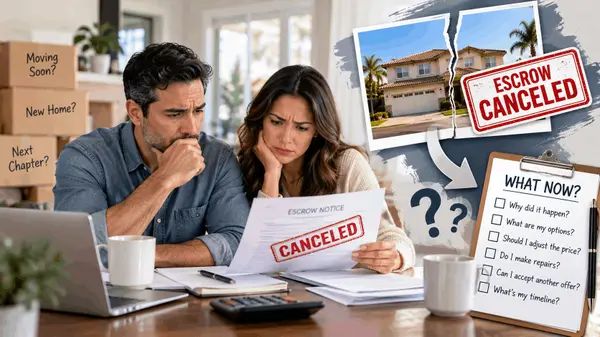
Your Buyer Canceled Escrow on Your Chino Home. What Should You Do Next?
Your Buyer Canceled Escrow on Your Chino Home. What Should You Do Next? Your buyer canceled escrow. But your reason for selling didn't disappear. You finally received an offer on your house. You negotiated the price. You signed the purchase agreement. You opened escrow. And you started making plans

Your Employer Is Relocating You: 9 Questions to Ask Before Selling Your Chino Home
Your Employer Is Relocating You: 9 Questions to Ask Before Selling Your Chino Home Your employer gave you a start date. But your house doesn't have a guaranteed closing date. Maybe you just received a promotion. A better salary. An opportunity to advance your career. Or perhaps your employer announc