
What Does It Mean to Be a Contingent Buyer or Seller? How to Sell Your House and Buy Another Without Feeling Stuck
You want to move.
Maybe your family needs more space.
Maybe there's a baby on the way.
Maybe you need a home that works better for multigenerational living.
Maybe you're an empty nester and want to downsize.
Maybe you need a one-story home.
Maybe your job is relocating you.
Or maybe your current house simply doesn't fit your life anymore.
But there's one question stopping you:
“What if I sell my house and can't find another property?”
We hear this all the time.
Homeowners tell us:
“I need to know where I'm going before I put my house on the market.”
“I don't want to sell and have nowhere to live.”
“What happens if someone buys my house before I find the next one?”
“Can I make an offer on another house if mine hasn't sold?”
These are legitimate concerns.
And our answer isn't:
“Don't worry about it. Just put your house on the market.”
Our answer is:
Let's understand your options, build the strategy and then decide what makes sense.
Because selling your current home while purchasing another isn't simply one real estate transaction.
It's potentially two transactions that need to work together.
And one of our biggest responsibilities when helping a contingent buyer or seller is to keep the process organized, explain what's happening before it happens, anticipate potential problems and reduce as much unnecessary stress and uncertainty as possible.
You don't need to understand every detail before starting.
That's what we're here to help you understand.
What Does “Contingent” Mean in Real Estate?
A contingency is essentially a condition within a real estate contract that must be satisfied, addressed or removed according to the terms of the agreement.
There can be different contingencies in a real estate transaction.
But when homeowners tell us:
“We're contingent buyers,”
they often mean something more specific:
They need to sell their current home in order to complete the purchase of their next home.
Maybe you have $300,000, $500,000 or even more equity in your current house.
That's great.
But that equity isn't necessarily sitting in your checking account.
It may still be tied up in the property.
You may need the proceeds from the sale of your current home for the down payment on the next one.
That means the two transactions may become connected.
And this is where homeowners need to understand something extremely important:
Not All Contingent Buyers Are Equally Strong
There are different stages of being a contingent buyer.
We generally explain them as four levels.
The further along your current sale is, the stronger your position may appear to the seller of the property you're trying to purchase.
Let's break them down.
Level 1: You Want to Make an Offer, but Your Current House Isn't on the Market
Generally speaking, this is the weakest of the four contingent positions.
You found the house you want.
You want to make an offer.
But your current property:
Isn't listed.
Doesn't have an accepted offer.
Isn't in escrow.
And hasn't been exposed to the market yet.
Now we want you to do something we believe is extremely important in real estate negotiations:
Put yourself in the other person's shoes.
Imagine you're the seller receiving this offer.
Before this buyer can purchase your property, their current home may still need to:
Be prepared for sale.
Be priced.
Be listed.
Find a buyer.
Receive an acceptable offer.
Open escrow.
Work through the buyer's applicable contingencies.
And ultimately close.
That's a lot of steps that haven't happened yet.
Does that mean the seller won't accept your offer?
Absolutely not.
But depending on the market and the seller's circumstances, they may view your offer as carrying more uncertainty than another offer that doesn't depend on a future home sale.
Level 2: Your House Is on the Market, but You Don't Have an Accepted Offer Yet
Now you've moved up a level.
Your property is actively listed.
Buyers can find it.
We're able to monitor:
Online views.
Saves and favorites.
Showing activity.
Open-house activity.
Buyer feedback.
Days on market.
Competing properties.
And overall market response.
But there's still an unanswered question:
When will your house actually go into escrow?
From the seller's perspective on the house you're trying to buy, that still represents uncertainty.
However, we're now in a better position to evaluate the likelihood of your property selling.
If your house has strong activity, multiple showings and interested buyers, that's different from a property that has been sitting on the market with little activity.
The details matter.
Level 3: Your Current House Is Already in Escrow
Now your position may become considerably stronger.
Your home has already:
Been prepared.
Been listed.
Found a buyer.
Received an offer.
Had that offer negotiated and accepted.
And entered escrow.
There's now an actual transaction underway.
That doesn't mean your home is guaranteed to close.
The buyer may still have applicable contractual contingencies involving inspections, financing, appraisal or other matters.
But you've eliminated several of the unknowns that existed at Levels 1 and 2.
When we present your offer on the replacement property, we're now able to say:
“Their current home is already in escrow.”
That's meaningful information.
Level 4: Your House Is in Escrow AND Your Buyer Has Removed All Applicable Contingencies
Of these four situations, this can generally represent the strongest contingent position.
Your current property is already in escrow.
And the buyer purchasing it has removed the applicable contractual contingencies.
Is the transaction guaranteed?
No.
A house isn't sold until the transaction actually closes.
But compare these two buyers:
Buyer #1 says:
“We need to sell our house, but we haven't listed it yet.”
Buyer #2 says:
“Our house is already in escrow, our buyer has removed all applicable contingencies, and we're progressing toward closing.”
Both may technically have a purchase that depends on another sale.
But from the replacement seller's perspective:
Those are two very different levels of risk.
That's why we want our clients to understand these four levels before they fall in love with a property.
Why We Recommend Preparing Your Current House BEFORE You Fall in Love With the Next One
This is one of the biggest lessons we can give someone who needs to sell in order to buy.
We've seen this happen many times.
A homeowner tells us:
“We're just looking.”
Then they find a house.
And not just any house.
THE house.
Suddenly they're picturing their furniture inside.
The kids have picked their bedrooms.
They know where the Christmas tree will go.
They're imagining family dinners in the kitchen.
They're emotionally invested.
And then reality hits:
Their current house isn't even on the market.
Now everything becomes urgent.
When You Fall in Love First, You May Put Yourself Under Unnecessary Pressure
Suddenly you're trying to:
Prepare your house.
Make repairs.
Determine pricing.
Schedule photography.
Launch the listing.
Accommodate showings.
Generate an offer.
Negotiate the offer.
Open escrow.
And move the transaction forward.
As quickly as possible.
Why?
Because you're afraid someone else is going to buy the house you want.
That pressure can affect your decision-making.
Maybe you rush the preparation.
Maybe you don't complete an improvement that could have helped your net proceeds.
Maybe you price more aggressively because you desperately need an offer.
Maybe you accept an offer faster than you otherwise would.
Maybe you agree to terms you would have negotiated differently if you weren't under pressure.
And that can potentially mean leaving money on the table.
Selling quickly isn't necessarily bad.
Sometimes speed is exactly what a homeowner needs.
But there's a major difference between:
Choosing speed strategically
and
being forced into speed because you've already fallen in love with another property.
That's why we highly recommend having a plan for your current home before you become emotionally attached to the next one.
Preparing Your House Doesn't Mean You Have to Sell It Tomorrow
This is an important distinction.
We're not saying:
“Put your house on the market immediately.”
We're saying:
Prepare yourself.
Understand what your home could realistically sell for.
Know approximately what you could net.
Determine what improvements, if any, make financial sense.
Talk with your lender.
Understand your purchasing power.
Start studying replacement properties.
Understand the neighborhoods you're considering.
Determine how frequently homes meeting your criteria become available.
Understand whether you're entering a buyer's market or seller's market.
And build the plan.
Planning does not obligate you to sell.
It gives you options.
And options can create leverage.
“But What If I Sell My House and Can't Find Another One?”
This is probably the biggest question of all.
And we want homeowners to understand:
Selling your home and simply hoping you find somewhere to live isn't the only possible strategy.
Depending on your finances, contracts, market conditions, risk tolerance and what the other parties are willing to negotiate, there may be several options.
Let's look at them.
Option 1: Sell Contingent on Finding or Acquiring a Replacement Property
Depending on the circumstances and agreement of the parties, it may be possible to negotiate a sale with a contingency involving the seller finding or acquiring a suitable replacement property.
In simple terms:
You're trying to create protection so you're not simply selling your house without addressing where you're going next.
But remember our rule:
Think like the other side.
The buyer purchasing your house also has needs.
They may wonder:
“How long will I have to wait?”
“What happens if the seller doesn't find another property?”
“Can I make plans around this closing date?”
Some buyers may be perfectly comfortable with those terms.
Others may not.
That is why every option has to be evaluated from both sides.
Option 2: Negotiate a Seller Rent-Back
Another potential option is a seller rent-back, when appropriate and agreed upon.
The concept is fairly straightforward.
You sell your house.
Escrow closes.
The buyer becomes the owner.
But you negotiate an agreement allowing you to remain in the property for an agreed period after closing.
That additional time may give you breathing room to complete your replacement purchase and coordinate your move.
Instead of feeling like:
“My house closes Friday, so I have to be completely out Friday,”
you may have additional time, depending on the agreement.
But a seller rent-back isn't automatic.
Terms need to be negotiated.
The buyer has to agree.
Financing or occupancy requirements may affect what's possible.
Possession matters.
Insurance considerations may arise.
The duration matters.
And the agreement itself matters.
That's why we want to discuss a possible rent-back before negotiating the sale whenever possible, rather than trying to figure it out at the last minute.
Option 3: Close Concurrently on the Sale of Your Current Home and Purchase of Your New Home
Another option is to structure the transactions so the sale of your current property and the purchase of your replacement property close concurrently.
In simple terms:
Your current home closes → the proceeds from that sale become available → those funds are used toward your replacement purchase → the replacement-home transaction closes.
This can be particularly important when you need the equity from your current property to complete the next purchase.
But concurrent closings require careful coordination.
Now there are multiple parties involved:
The buyer purchasing your current home.
The seller of your replacement property.
Your buyer's lender, if applicable.
Your lender.
Escrow and title.
Agents.
Inspectors.
Appraisers when applicable.
And everyone else involved in the transactions.
There may be:
Inspection timelines.
Appraisal timelines.
Loan deadlines.
Contingency periods.
Contingency removals.
Closing dates.
Possession dates.
Funding.
Recording.
Moving schedules.
One delay can potentially affect the transaction that follows it.
That's why concurrent transactions need to be managed as interconnected pieces rather than two completely separate deals.
Option 4: Purchase Your Next Home Before Selling
For some homeowners, purchasing first may be possible.
You buy the new property.
Move into it.
Then prepare and sell your current house.
That can eliminate a lot of logistical pressure.
But it creates a different question:
Can you financially do it?
Talk with a qualified lender and determine:
Can you qualify while carrying your current mortgage?
Do you have sufficient funds for the down payment?
Can you comfortably carry two properties temporarily?
How long could you afford to do so?
What happens if your current property takes longer than expected to sell?
Don't assume. Run the numbers.
Sometimes homeowners discover this is possible when they thought it wasn't.
Other times they discover it creates more financial risk than they're comfortable taking.
Either answer is useful because now you know.
Option 5: Explore Bridge Financing or Other Financing Strategies
Depending on your finances and programs available through qualified lenders, there may be financing options designed to help bridge the gap between selling one property and purchasing another.
We're Realtors, not lenders.
We're not going to tell you which loan or financial product is right for you.
But we absolutely believe you should understand whether financing alternatives exist before deciding there's only one way to make the move.
Your lender becomes an important part of the planning team.
Option 6: Sell First and Use Temporary Housing
For some homeowners, selling first may provide the cleanest financial position.
You sell.
Your equity becomes available.
Your home-sale dependency is removed.
And you temporarily live somewhere else while finding the right replacement property.
That could mean:
A short-term rental.
Staying with family.
Or another temporary living arrangement.
Is moving twice ideal?
Probably not.
But some homeowners may decide the temporary inconvenience is worth the additional flexibility they have when making their next offer.
There isn't one correct strategy for everyone.
Our job is to explain the choices so you can determine which trade-offs you're comfortable making.
Sometimes It's a Buyer's Market. Sometimes It's a Seller's Market. That Changes the Strategy.
This is extremely important when discussing contingent offers.
A contingent offer does not exist in a vacuum.
The market matters.
Suppose you're trying to purchase during a strong seller's market.
The house receives seven offers.
Several buyers don't need to sell another property.
Now your contingency may create a competitive disadvantage.
Think like the seller:
“If I have another strong offer that doesn't depend on another property selling, why should I take the additional uncertainty?”
That's a fair question.
Now reverse the situation.
The property has been on the market for 45 days.
There are fewer buyers.
The seller hasn't received the offer they want.
Your current home is already in escrow.
Your buyer has removed applicable contingencies.
Now that same seller may evaluate your contingent offer very differently.
Same buyer.
Same contingency.
Different market.
Different leverage.
That's why blanket statements such as:
“Sellers don't accept contingent offers”
aren't necessarily accurate.
Every market is different.
Every seller is different.
Every property is different.
And every offer is different.
Learn to Think Like BOTH the Buyer and the Seller
We believe this is one of the most useful ways to understand real estate negotiations.
Sometimes you have to stop thinking about what you want for a moment and ask:
“What is the person on the other side thinking?”
When you're purchasing, think like the seller.
If you received your own offer, what would concern you?
Is your current house not listed?
Is it listed without an offer?
Is it in escrow?
Has your buyer removed applicable contingencies?
How long has the seller's property been available?
Are there multiple offers?
What alternatives does that seller have?
Now reverse it.
You're selling your current house.
Think like the buyer.
If you were spending this amount of money, how would you compare your property against everything else available?
Price?
Condition?
Location?
Features?
Monthly payment?
Competition?
When you're selling one house and buying another, you're playing both roles simultaneously.
Understanding both perspectives can make you a better negotiator and a better decision-maker.
The Contingency Periods on BOTH Transactions Matter
This is where experience becomes particularly important.
You're not dealing with one contract.
You may have:
The contract on the property you're selling.
AND:
The contract on the property you're purchasing.
Each transaction can have its own contractual timelines and contingency periods.
Depending on the transactions, those could involve matters such as:
Inspections.
Investigations.
Financing.
Appraisal.
Home-sale contingencies.
Replacement-property contingencies.
Contingency removals.
Closing.
Possession.
And other contractual deadlines.
These aren't simply dates on a calendar.
They can affect your risk, leverage and stress level.
Contingency Periods Can Alleviate Pressure—or Add Pressure
This is something we want clients to understand clearly.
Properly negotiated timelines can potentially give you the breathing room necessary to work through both transactions.
Poorly coordinated timelines can do the opposite.
Imagine you're purchasing your replacement property and approaching a deadline to remove an important contingency.
Meanwhile, the buyer purchasing your current home still has unresolved contingencies.
Now you may feel pressure on the purchase side while uncertainty remains on the sale side.
Or perhaps your current home is scheduled to close before your replacement property is ready.
Where will you live?
When will you move?
What happens to your belongings?
Could a rent-back help?
Could possession be negotiated differently?
Could closing dates be structured differently?
These are the conversations we want to have before they become emergencies.
The Shortest Contingency Period Isn't Automatically the Best Contingency Period
Sometimes people assume:
“If we make all of our contingency periods really short, our offer will look stronger.”
Potentially.
But that's only one side of the equation.
A contingency may provide important time to investigate the property, complete inspections, address financing, obtain an appraisal or satisfy another contractual condition.
The goal isn't simply:
“How quickly can we remove everything?”
The better question is:
“How do we make this offer as competitive as reasonably possible while appropriately protecting our client's interests?”
That's where negotiation matters.
When You're Selling and Buying, Your Agent Isn't Just Negotiating Price
Price gets most of the attention in real estate.
But when you're a contingent buyer and seller, your agent may also be negotiating:
Contingencies.
Contingency periods.
Closing dates.
Possession.
Seller rent-back.
Replacement-property terms.
Inspection issues.
Repairs.
Credits.
Appraisal issues.
And the coordination between your sale and purchase.
That's why we believe:
When you're selling one home to buy another, your agent isn't simply negotiating price. They're helping negotiate time, risk, leverage and protection across two interconnected transactions.
Why Experience Matters When You're a Contingent Buyer or Seller
Most real estate transactions encounter something unexpected.
Sometimes it's small.
Sometimes it's significant.
An inspection uncovers an issue.
An appraisal comes in differently than expected.
A lender needs additional documentation.
A buyer gets nervous.
A repair becomes a negotiation.
A contingency deadline approaches.
A closing gets delayed.
Possession becomes an issue.
Or something happens in one transaction that affects the other.
The question isn't whether every transaction will be perfect.
The question is: when a problem appears, who is helping you work through it?
Experience Isn't About Bragging—It's About Solutions
We've been selling real estate for more than two decades and have been involved in hundreds of transactions.
We don't tell you that to impress you.
We tell you because experience creates perspective and pattern recognition.
Think about it this way.
If you needed an important surgery, would you rather have a doctor who performs that particular procedure every now and then?
Or would you feel more comfortable with a surgeon who has been performing that procedure for more than two decades and has completed hundreds of surgeries?
Most people would probably choose the experienced surgeon.
Real estate obviously isn't surgery.
But the principle is similar.
Experience isn't valuable because an experienced professional can promise that nothing unexpected will ever happen.
Experience is valuable because they've encountered more situations, solved more problems and developed more judgment from those experiences.
Every real estate transaction we've completed has taught us something.
Every difficult inspection.
Every appraisal issue.
Every financing challenge.
Every difficult negotiation.
Every delayed closing.
Every contingent transaction.
Every unusual situation.
Every problem we've helped solve becomes another experience we can draw from when helping the next client.
Hundreds of transactions don't just represent hundreds of homes sold.
They represent hundreds of opportunities to learn how to solve problems.
And when you're simultaneously selling one home and purchasing another, that experience can become especially valuable.
Our Goal Is to Keep You Calm, Informed and Prepared
This may be the most important section of this entire article.
Buying and selling simultaneously can feel stressful.
There's money involved.
There are deadlines.
There are contracts.
There are multiple parties.
And you're also trying to figure out something very personal:
Where is my family going to live next?
Our job isn't to add to that pressure.
Our job is to help reduce it.
We want you to understand:
What's happening.
Why it's happening.
What happens next.
What deadlines are approaching.
What your options are.
What we're concerned about.
What we're not concerned about.
And what decisions actually need to be made today.
There's a big difference between hearing:
“We have a problem.”
and hearing:
“Here's what happened. Here are the options. Here's what each option means. Here's what we recommend. Let's decide together how we want to handle it.”
That's how we want our clients to experience the process.
We can't promise that every transaction will be stress-free.
That wouldn't be truthful.
But we can work to prevent unnecessary surprises, communicate clearly, anticipate issues when possible and help you work through problems when they arise.
Sometimes the best way to reduce stress isn't eliminating every problem.
It's knowing that when a problem appears, you have someone helping you figure out the next move.
What Does the Process Look Like When You Need to Sell Before You Buy?
If you came to us and said:
“Leticia and Alberto, we want to move, but we need to sell this house to buy the next one. Where do we start?”
Here's how we'd approach the conversation.
Step 1: Understand WHY You're Moving
Why does the current house no longer work?
Growing family?
Baby coming?
Multigenerational living?
Downsizing?
Empty nest?
Relocation?
One-story living?
Moving closer to family?
Different location?
And:
Is there a deadline?
Your reason for moving influences the strategy.
Step 2: Determine What Your Current Home Could Realistically Sell For
Before planning the purchase, let's understand what you're selling.
We evaluate your property and the current market so you have a realistic idea of value.
Step 3: Estimate Your Net Proceeds
If you're depending on your equity to purchase the next property, we want to estimate approximately what may be available after your sale.
Sale price and net proceeds are two different numbers.
Step 4: Talk With Your Lender (we can refer you to our preferred lender)
Determine:
What can you qualify for?
Do you actually need to sell first?
Could you purchase first?
How much down payment will you need?
What might the new payment look like?
Are there financing strategies worth exploring?
Because financing can affect both sides of a contingent move, it's also important to understand what the Federal Reserve's latest interest-rate increase could mean for today's Chino and Chino Hills home buyers and sellers.
Step 5: Study the Replacement Market BEFORE You Commit to Selling
Let's see what's actually available.
Maybe there are 25 properties that could work.
Maybe there are three.
That matters.
We want to understand:
Inventory.
Price range.
Locations.
Competition.
Market time.
And how frequently properties matching your criteria become available.
Step 6: Choose the Sell/Buy Strategy
Now we can evaluate:
Selling first.
Buying first.
Selling with an appropriate replacement-property contingency.
Negotiating a seller rent-back.
Closing concurrently.
Exploring financing alternatives.
Using temporary housing.
Or potentially combining strategies.
Step 7: Prepare and Position Your Current Home
If selling your current property is necessary for the next purchase, then its success becomes part of your buying strategy.
Preparation matters.
Pricing matters.
Marketing matters.
Showing activity matters.
Buyer feedback matters.
Negotiation matters.
Remember the progression:
Not listed → Listed → In escrow → Buyer contingencies removed → Closed.
Each stage may change how a seller evaluates your contingent offer.
Step 8: Find the Replacement Property and Present Your Offer Strategically
When we find the right property, we're not simply submitting a price.
We're presenting the entire offer.
If you're contingent, we want the seller and their agent to understand exactly where your sale stands.
There's a huge difference between:
“They need to sell their house.”
and:
“Their property is already in escrow and their buyer has removed all applicable contingencies.”
Step 9: Negotiate and Monitor BOTH Transactions
Once both properties are in escrow, we're monitoring:
Contingencies.
Inspections.
Appraisals.
Loan progress.
Escrow.
Deadlines.
Contingency removals.
Closing dates.
Possession.
Rent-back when applicable.
And anything on one side that could affect the other.
Step 10: Close Concurrently and Coordinate the Move
When the transactions are structured to close concurrently, the goal is for the sale of your existing property and purchase of the replacement property to work together.
But we're not just coordinating contracts.
We're coordinating your move from one chapter of your life into the next.
Frequently Asked Questions About Contingent Buyers and Sellers
What Is a Contingent Buyer?
A contingent buyer commonly refers to someone whose purchase of another property depends upon the sale of their existing home or the proceeds from that sale.
Can I Make an Offer on a House Before Mine Is Listed?
Potentially, yes.
However, if your purchase depends on selling your current property, generally that can be a weaker contingent position than having your home already listed, in escrow or further progressed toward closing.
Should I Put My House on the Market Before Finding Another Home?
It depends on your financial circumstances, market conditions, replacement-home availability and comfort with risk.
However, we strongly recommend developing the sale strategy before you fall in love with another house so you aren't forced to make rushed decisions with your current property.
What If My House Sells and I Can't Find Another Property?
Depending on your circumstances and what can be negotiated, options may potentially include a replacement-property contingency, seller rent-back, concurrent closing, purchasing first, temporary housing or financing alternatives.
The important thing is understanding those options before you sell.
What Is a Concurrent Closing?
A concurrent closing generally refers to coordinating the closing of your current home sale with the closing of your replacement-home purchase so the transactions occur together or in close coordination.
This can be particularly useful when proceeds from the sale are needed to complete the next purchase.
Can I Stay in My House After It Sells?
Potentially.
A seller rent-back or other properly negotiated possession arrangement may allow the seller to remain in the property for an agreed period after closing, subject to the buyer's agreement and the specific terms and circumstances.
Is a Contingent Offer Weaker?
It can be less competitive than an otherwise comparable offer without a home-sale dependency.
But where you are in the sale process matters tremendously.
There's a major difference between a house that isn't listed and one already in escrow with the buyer's applicable contingencies removed.
Can a Contingent Offer Get Accepted in a Seller's Market?
Potentially.
However, competition may make it more challenging, particularly when the seller has other strong offers without home-sale contingencies.
That's why the entire offer and status of your current sale matter.
Are Contingent Offers Easier in a Buyer's Market?
They may be.
When sellers have fewer competing offers, they may be more willing to consider a well-structured contingent offer.
Every property and negotiation is different.
How Can I Make My Contingent Offer Stronger?
Preparation matters.
Understand your financing.
Prepare your current home.
Get it on the market when appropriate.
Price it strategically.
Generate buyer activity.
Get into escrow.
Keep the transaction progressing.
And make sure the seller of the replacement property understands exactly where your sale stands.
Should I Remove Contingencies Quickly to Make My Offer Stronger?
Not automatically.
Shorter contingency periods may make an offer more attractive in some circumstances, but contingency periods can also provide important contractual protections.
The objective should be balancing competitiveness with appropriate protection for your particular circumstances.
Why Are You Reading This Blog?
Because if you're thinking:
“We want to move, but we're scared to sell because we don't know where we're going,”
we don't want fear of the unknown to make the decision for you.
You don't have to know every answer.
You don't have to understand every contract.
You don't have to know how two closings work.
You don't have to know what contingency periods should be negotiated.
You don't have to know whether you should ask for a rent-back.
You don't have to know whether you should sell first or buy first.
That's what the planning conversation is for.
Our job is to explain the options.
Tell you the truth about the advantages and disadvantages.
Help you understand the risks.
Answer your questions.
Develop the strategy.
Negotiate with your interests in mind.
Keep you informed.
And when something unexpected happens, help you work through the possible solutions.
Sometimes we'll tell you:
“You're in a strong position.”
Sometimes we'll tell you:
“We think your current house should be further along before you compete for that property.”
Sometimes we'll tell you:
“Let's explore another option.”
And sometimes our recommendation may simply be:
“You're not ready yet. Let's prepare first.”
Because good representation isn't telling clients what they want to hear.
It's helping them understand enough to make an informed decision.
Final Thoughts: Build the Plan Before You Need the Plan
If you're considering selling your current house and purchasing another, don't wait until you find the house you love to figure everything out.
Start the conversation early.
Understand what your current home could realistically sell for.
Understand your estimated net proceeds.
If you’re not sure how to estimate that number, our guide to the cost of selling a house in Chino explains the major seller expenses and how to estimate your potential net proceeds before you start planning the purchase of your next home.
Talk with your lender.
Understand your purchasing power.
Study the replacement market.
Understand the four levels of contingent-buyer strength.
Determine whether you're operating in a buyer's market or seller's market.
Discuss potential contingency periods.
Explore replacement-property options.
Understand how a rent-back might work.
Determine whether closing concurrently makes sense.
Understand what happens if something gets delayed.
And then:
Build the plan.
The goal isn't to pressure you into selling your house.
The goal isn't to promise that nothing will go wrong.
And the goal isn't to pretend that being a contingent buyer doesn't present challenges.
The goal is to make sure you understand those challenges and have a strategy for dealing with them before they become stressful surprises.
If you're thinking about selling a home in Chino, Chino Hills, the Inland Empire or Orange County because life is creating the need for your next move, Leticia and Alberto Sotomayor can help you understand how the sale of your current property and purchase of your next property may work together.
Let's answer your questions before you make the decision.
Let's understand your home.
Let's understand your equity.
Let's understand your financing.
Let's understand where you're going.
Let's understand the market.
Let's understand your options.
Then let's build the strategy around you.
Ready to Understand Your Options?
If the thought running through your mind is:
“I'd move, but I'm afraid to sell because I don't know where I'm going next,”
that's exactly the conversation we should have.
You don't need to be ready to list your home tomorrow.
You just need to be ready to understand your options.
Reach out to Leticia and Alberto Sotomayor and let's map out what selling your current home and purchasing your next home could actually look like before you make any commitments.
Because sometimes the biggest source of stress isn't the move itself.
It's not knowing what happens next.
And that's where having a plan—and experienced agents guiding you through it—can make all the difference.
The market does not create every move. Life does. Our job is to organize the real estate decisions, reduce uncertainty and help families move forward.
Professional Disclaimer
This article provides general real estate information and is not legal, tax, lending or financial advice. Every transaction and contract is different. Contingencies, contingency removal, seller possession or rent-back arrangements, concurrent closings and financing strategies can involve specific contractual, lending, insurance and legal considerations. Buyers and sellers should review their specific agreements and consult the appropriate qualified professionals regarding matters outside the scope of real estate brokerage.
FROM OUR BLOG


Hottinger Family Meats in Chino, CA: A Local Tradition Since 1948
Hottinger Family Meats in Chino, CA: A Local Tradition Since 1948 Some places are more than businesses. They become part of your childhood, your family gatherings, and the memories you carry long after you grow up. For me, Hottinger Family Meats in Chino is one of those places. I’ve been going to Ho

Waiting Until Spring 2027 to Sell Your Chino Home? Start Preparing Now
Thinking About Selling Your Chino Home in Spring 2027? Start Preparing Now If you are waiting until spring 2027 to sell your Chino or Chino Hills home, you may be making a smart timing decision. But waiting to list and waiting to prepare are two very different things. A homeowner can spend months de
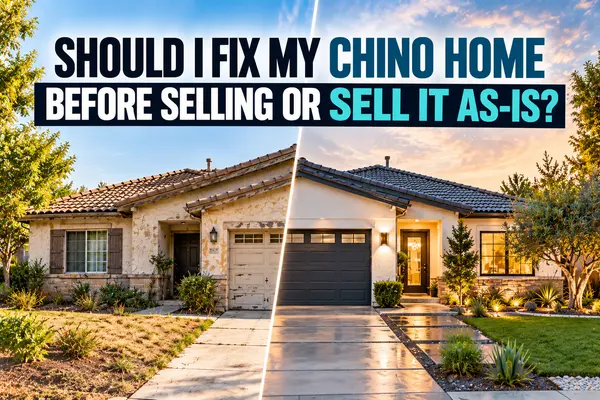
Should I Fix My Chino Home Before Selling or Sell It As-Is?
Should I Fix My Chino Home Before Selling or Sell It As-Is? Your Chino home needs a new roof, the kitchen hasn’t been updated in 25 years, and the flooring has seen better days. Do you really need to spend $50,000 before you can sell? Maybe you’re retiring. Maybe you’re downsizing from a two-story h