
Why Some Homes Sell Faster Than Others
You’ve probably noticed it.
One home goes on the market and receives multiple showings almost immediately.
Another home, just a few streets away, sits on the market for weeks—or even months—with very little activity.
Many homeowners assume the difference is mortgage interest rates.
While interest rates certainly affect affordability, they're usually not the biggest reason one home sells quickly while another struggles to attract buyers.
More often than not, the deciding factor is pricing strategy.
In today's real estate market, buyers have access to more information than ever before. They aren't just looking at your home—they're comparing it to every other home currently available.
Understanding how buyers make decisions can help sellers avoid one of the most expensive mistakes in real estate.
Today's Buyers Shop Differently
Years ago, buyers relied heavily on their real estate agent to find homes.
Today, buyers often spend weeks—or even months—researching online before they ever schedule a showing.
They're comparing:
-
Asking prices
-
Monthly mortgage payments
-
Property taxes
-
Homeowners insurance
-
HOA dues
-
Home condition
-
Recent upgrades
-
Days on market
-
Seller concessions
-
Neighborhood location
Every new listing is instantly compared against dozens of competing homes.
That means buyers aren't asking:
"Is this a nice house?"
They're asking:
"Is this the best value available today?"
The First Two Weeks Matter Most
The first days after your home hits the market are often the most important.
That's when:
-
New listing alerts are sent
-
Serious buyers schedule showings
-
Buyer agents notify their clients
-
Online traffic is typically at its highest
If your home enters the market with a competitive pricing strategy, you have the greatest opportunity to generate excitement and attract qualified buyers.
When a home is priced too high, that momentum can disappear quickly.
Overpricing Often Has the Opposite Effect
Many sellers believe pricing higher gives them room to negotiate.
Unfortunately, today's buyers usually don't see it that way.
Instead, an overpriced home may:
-
Receive fewer online views
-
Generate fewer showings
-
Spend more time on the market
-
Require multiple price reductions
-
Raise questions about why it hasn't sold
Ironically, homes that start too high often sell for less than they might have if they had been priced correctly from the beginning.
Price Creates Traffic—Value Creates Offers
Pricing gets buyers through the front door.
Value is what convinces them to write an offer.
That's why successful sellers focus on more than just the list price.
They also create value by:
-
Presenting a clean, well-maintained home
-
Completing important repairs
-
Improving curb appeal
-
Using professional photography
-
Marketing the property effectively
-
Offering flexibility when appropriate
When buyers believe they're getting outstanding value, they're much more likely to compete for the home.
Buyers Compare Monthly Payments, Not Just Price
One of the biggest shifts we've seen in today's market is how buyers evaluate affordability.
Instead of focusing only on the purchase price, many buyers calculate:
-
Estimated monthly payment
-
Insurance costs
-
Property taxes
-
HOA dues
-
Utility expenses
-
Maintenance costs
Two homes with similar asking prices can feel very different depending on the total monthly cost of ownership.
That's another reason pricing alone doesn't tell the whole story.
Local Market Knowledge Matters
National headlines rarely reflect what's happening in your neighborhood.
Real estate is local.
Buyer demand, available inventory, neighborhood appeal, and pricing trends can vary dramatically from one community to another.
That's why a pricing strategy that works in one city may not be the best approach in another.
For homeowners in Chino, Chino Hills, the Inland Empire, and Orange County, understanding local market conditions is one of the most important parts of preparing to sell.
The Cost of Chasing the Market
Every price reduction represents time that can't be recovered.
As a home sits on the market, buyers may begin wondering:
-
Is something wrong with the property?
-
Why hasn't it sold?
-
Will the seller accept less?
Those questions can reduce negotiating leverage and ultimately impact the final sale price.
Pricing strategically from day one often creates stronger interest and helps sellers maintain momentum.
Alberto & Leticia's Perspective
After helping families buy and sell homes throughout Chino, Chino Hills, the Inland Empire, and Orange County for more than two decades, we've learned something important.
The homes that create the most excitement aren't always the least expensive.
They're the homes buyers believe offer the best overall value.
Our goal has never been to simply put a home on the market.
Our goal is to help our clients position their home so it stands out from the competition and attracts serious buyers from the very beginning.
A thoughtful pricing strategy isn't about leaving money on the table.
It's about creating the conditions that allow buyers to see your home's true value.
Frequently Asked Questions
Should I price my home higher so I have room to negotiate?
Not necessarily. Overpricing can reduce showings and cause your home to remain on the market longer. A strategic price based on current market conditions often produces stronger buyer interest.
Do mortgage rates still affect buyers?
Yes. Mortgage rates influence affordability, but buyers also consider monthly payments, home condition, insurance costs, taxes, and the overall value of the property.
Why are the first two weeks so important?
That's when your listing receives the greatest exposure to motivated buyers and buyer agents. A strong first impression can create momentum that benefits your sale.
What is the biggest mistake sellers make?
One of the most common mistakes is pricing a home based on emotion or outdated comparable sales rather than current market conditions and active competition.
Can seller concessions help instead of lowering the price?
Yes. Depending on the situation, seller-paid closing costs or temporary mortgage-rate buydowns may improve affordability without requiring a significant price reduction.
Your Next Step
If you're thinking about selling your home, don't rely on guesswork or national headlines.
Every neighborhood has its own story.
The right pricing strategy starts with understanding your local market, your competition, and what today's buyers are looking for.
If you're curious about what your home could sell for in today's market—or you'd simply like to discuss your options—we'd be honored to help.
Contact Leticia & Alberto Sotomayor for a personalized home value consultation and discover the pricing strategy that fits your goals.
FROM OUR BLOG
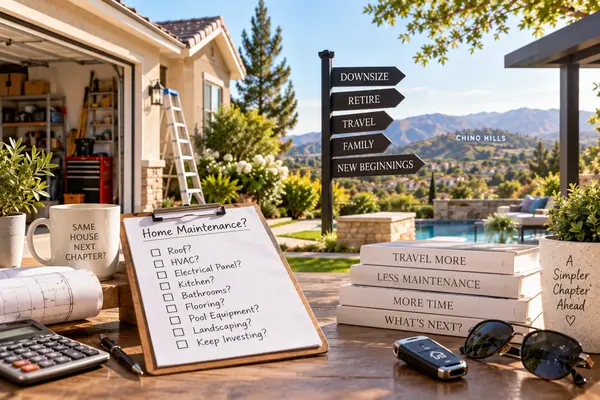

Downsizing in Chino or Chino Hills: What If the Smaller Home Costs Almost as Much?
Downsizing in Chino or Chino Hills: What If the Smaller Home Costs Almost as Much? You've lived in your Chino or Chino Hills home for 20, 25 or maybe 30 years. It was the right house for that chapter of your life. Four bedrooms. Two stories. A pool. A large yard. Plenty of room for the kids. Maybe b

Your Aging Parents Need You Closer—Should You Sell Your Chino or Chino Hills Home to Help Care for Them?
Your Aging Parents Need You Closer—Should You Sell Your Chino or Chino Hills Home to Help Care for Them? You love your Chino or Chino Hills home. Maybe your children are settled in school. Your friends are nearby. Your commute works. You know your neighbors. You have a mortgage payment you're comfor

Selling Your Chino or Chino Hills Home and Retiring Outside California—Should You Stay or Move?
Selling Your Chino or Chino Hills Home and Retiring Outside California—Should You Stay or Move? For decades, your Chino or Chino Hills home may have been exactly where you needed it to be. It was close to work. It was where you raised your children. Where birthdays happened. Where holidays were cele