
What Should I Do Before Putting My House on the Market? 10 Things Every Seller Should Know
If you're thinking about selling your house, one of the first questions you may be asking is:
“What should I do before putting my house on the market?”
Most homeowners immediately think about things like:
Should I paint?
Should I replace the flooring?
Should I remodel the kitchen?
Should I stage the house?
Should I clean up the landscaping?
Those things can matter.
But preparing a home for sale involves much more than making the house look good.
Before the For Sale sign goes in the yard, you should understand:
Why you're moving.
What your home is realistically worth.
Approximately how much money you may walk away with.
Which repairs are actually worth making.
How today's buyers will compare your property with competing homes.
And what your strategy will be once the property goes live.
For homeowners in Chino, Chino Hills, the Inland Empire and Orange County, the goal shouldn't simply be to put your house on the market.
The goal should be to prepare the property, understand your numbers and build the strategy before buyers ever see the listing.
Because you only get one opportunity to be a brand-new listing.
Here are the 10 things we believe every homeowner should consider before putting a house on the market.
1. Know Why You're Selling—and Your Timeline
Before discussing paint colors, photography or list price, answer one question:
Why are you moving?
There is a major difference between someone who wants to move and someone whose life has created a need to move.
Maybe:
Your employer is relocating you.
Your family is growing and you need more space.
You have a baby on the way.
You're combining households for multigenerational living.
You're going through a divorce.
You inherited a property.
Mom or Dad can no longer safely live in the house.
You're retiring.
You're an empty nester and want to downsize.
You need a one-story property.
You've already purchased your next home.
Or you're moving closer to family.
Your reason for moving matters because it helps determine your timeline and strategy.
Someone who says:
“If we get our price, maybe we'll move.”
has a very different situation than someone who says:
“My employer needs me in Texas in 60 days.”
Before listing, determine:
When would you ideally like to move?
Is there a deadline?
What happens if the property takes longer to sell?
Do you need the proceeds to purchase your next home?
Will you buy first or sell first?
Could you temporarily carry two properties?
Where are you going next?
The market doesn't create every move.
Life does.
Your selling strategy should be built around the move you're actually trying to accomplish.
2. Know What Your House Is Realistically Worth Today
This sounds obvious.
But it is one of the most important parts of preparing to sell.
Your home's value isn't necessarily:
What you paid for it.
What you spent remodeling it.
What your neighbor says it's worth.
What an online estimate says.
What another home was listed for.
Or the amount you need to purchase your next house.
Your home's market value is ultimately influenced by what today's buyers are willing to pay relative to the alternatives available to them.
A strong pricing analysis should look at more than homes that already sold.
We also want to understand:
Recent comparable sales.
Current active listings.
Pending properties when information is available.
Recent price reductions.
Days on market.
Condition.
Location.
Lot size.
Floor plan.
Upgrades.
Buyer demand.
Inventory.
Seller incentives.
And what buyers can purchase instead of your home.
Why do active listings matter?
Because a buyer can't purchase the house that sold three months ago.
They can purchase the homes available today.
Your property will compete against those homes for the buyer's attention, showing appointment and ultimately their offer.
3. Calculate Your Estimated Net Proceeds Before You List
A $900,000 sale does not mean you're walking away with $900,000.
Before listing, ask:
“Approximately how much money could we actually walk away with?”
Your estimated proceeds may be affected by things such as:
Mortgage payoff.
Real estate-related expenses.
Escrow and title expenses.
Potential repairs.
Negotiated seller credits.
Liens or property-related obligations.
HOA-related expenses when applicable.
Other transaction-specific costs.
The exact expenses vary from transaction to transaction.
That's why we like sellers to see an estimated net sheet before making major decisions.
Suppose you're selling because you need $250,000 of your equity for the down payment on your next property.
The most important number isn't necessarily:
“What can we sell for?”
It's:
“Approximately what will we net?”
That number helps you plan the next chapter.
4. Understand Any Tax or Legal Questions Before You Sell
For many traditional home sales, this may be fairly straightforward.
For others, it can be extremely important.
Pay particular attention if the property involves:
An inheritance.
A trust.
Probate.
Divorce.
An investment property.
A longtime primary residence with substantial appreciation.
Multiple owners.
An estate.
Or another unusual ownership situation.
For example, homeowners may have questions about capital gains.
Families who inherited a property may have questions involving cost basis or Proposition 19.
Divorcing homeowners may have questions about ownership and proceeds.
Trustees may have questions about their authority to sell.
Those questions should be addressed before the transaction whenever possible, not after you're already in escrow.
Important Professional Disclaimer
Leticia and Alberto Sotomayor are licensed real estate professionals, not CPAs, accountants, tax advisers, financial advisers or attorneys. We provide real estate information within the scope of our role as Realtors and do not provide tax, accounting, financial or legal advice.
Every homeowner's circumstances are different. Before making decisions based on potential tax consequences, ownership rights, estate matters, Proposition 19, capital gains, cost basis, divorce, probate, trust administration or other legal or tax matters, consult your own qualified CPA or tax professional and appropriate legal counsel.
5. Decide What to Fix—and What NOT to Fix
This is where sellers can spend a lot of unnecessary money.
Before putting $20,000, $30,000 or $50,000 into a property, ask:
“Will this investment actually put more money back in our pocket?”
There's a difference between something that makes the house look better and something that produces a positive financial return.
Depending on the home and market, worthwhile preparation might include:
Fresh paint.
Professional cleaning.
Carpet cleaning or replacement.
Minor drywall repairs.
Updating obviously broken fixtures.
Improving landscaping.
Pressure washing.
Cleaning windows.
Replacing burned-out bulbs.
Addressing noticeable deferred maintenance.
But does every house need:
A new kitchen?
New bathrooms?
New flooring throughout?
A $40,000 backyard renovation?
Absolutely not.
Sometimes a seller spends $30,000 preparing a house only to increase the sale price by approximately the same amount—or less.
That's not necessarily a good investment.
Ask a better question:
“What improvements are most likely to improve our NET result?”
Sometimes the answer is making improvements.
Sometimes it's making only strategic improvements.
And sometimes the right strategy is selling the property largely as-is.
6. Declutter, Depersonalize and Create Space
One of the least expensive ways to improve a home's presentation is often simply removing excess items.
When buyers walk through your house, you want them thinking:
“I can see us living here.”
Not:
“There is stuff everywhere.”
Before listing:
Clear excessive items from kitchen countertops.
Remove unnecessary or oversized furniture when appropriate.
Reduce clutter on bathroom counters.
Remove excessive decorations and personal items when appropriate.
Straighten and organize living spaces.
Make sure walkways and rooms feel open and easy to navigate.
Start packing items you already know you won't need before the move.
The goal isn't to make the home look empty or like nobody lives there.
You still live there. Your home should still function for your family while it's on the market.
The objective is simply to make each room feel clean, open and easy for a buyer to understand.
You want buyers looking at the home's space, layout and features—not being distracted by the things inside it.
You aren't trying to erase your life from the house. You're simply creating enough visual space for buyers to imagine theirs.
7. Make the First Impression Count Before Buyers Walk Through the Door
The showing doesn't begin when the buyer enters the house.
It begins when they pull up.
What do they see?
Overgrown landscaping?
Dead grass?
Trash cans?
Cobwebs?
A dirty front door?
Peeling paint?
Or a clean, inviting property that looks cared for?
Depending on the property, consider:
Trimming landscaping.
Removing weeds.
Cleaning walkways.
Pressure washing where appropriate.
Cleaning the front door.
Touching up exterior paint when needed.
Cleaning exterior light fixtures.
Replacing burned-out bulbs.
Cleaning windows.
Making sure the address is clearly visible.
Removing unnecessary items from the front yard.
You don't necessarily need to spend thousands of dollars.
Sometimes a few hundred dollars and a weekend of work can dramatically change the first impression.
And remember:
The exterior may also be the first photograph buyers see online.
8. Prepare the Home for Professional Photography—and the Online Buyer
This is one of the most important changes in modern real estate.
Your first showing may not happen inside the house.
It may happen on a buyer's phone.
Before a buyer schedules an appointment, they may already have compared your property with several competing homes.
They may look at:
Price.
Photos.
Square footage.
Bedrooms.
Bathrooms.
Lot size.
Location.
Upgrades.
Monthly payment.
HOA.
Property condition.
Days on market.
Price history.
Nearby sales.
Schools.
And competing listings.
All before deciding whether your home deserves an appointment.
That's why photography and online presentation matter.
Before photography:
Open blinds and curtains when appropriate.
Turn on lights.
Clean reflective surfaces.
Remove clutter.
Hide trash cans.
Remove unnecessary countertop appliances.
Make beds.
Clean the kitchen.
Clean bathrooms.
Remove excessive refrigerator magnets and papers.
Straighten furniture.
Prepare the backyard.
Clean the pool if applicable.
Remove cars from the driveway when possible.
And make sure every room has a clear purpose.
Professional photography cannot fix a poorly prepared house.
Preparation and photography work together.
9. Gather Important Property Information Before Buyers Start Asking
Don't wait until you're deep into the transaction to start looking for important information.
Before listing, begin gathering relevant property records and information you have available.
Depending on the property, this could include:
Information about major improvements.
Roof information.
HVAC information.
Solar documentation.
HOA information.
Warranties.
Pool equipment information.
Major repair records.
Other property-specific documentation.
California sellers also have various disclosure obligations that can depend on the transaction and property.
Your Realtor can help explain the real estate disclosure process and forms that apply to the transaction, while legal questions should be directed to appropriate legal counsel.
The objective is simple:
Be prepared before buyers start asking questions.
10. Have Your Pricing, Launch, Showing AND Feedback Strategy Ready Before Going Live
This may be the most important step because it's where everything comes together.
Do not put your house on the market just to:
“See what happens.”
Have a plan.
Before going live, understand:
Your pricing strategy.
Your current competition.
Your photography and marketing plan.
When the listing will launch.
How showings will work.
How quickly buyers can access the property.
How open houses will be handled.
What buyer activity you'll monitor.
How feedback will be communicated.
And what would cause you to consider changing the strategy.
Once the property goes live, we want to monitor things such as:
Online views.
Saves and favorites.
Showing requests.
Open-house attendance.
Buyer feedback.
Repeat showings.
Offers.
New competing listings.
Competing price reductions.
Pending sales.
Days on market.
Because the market communicates.
And it communicates through buyer behavior.
What If My House Gets Online Views but No Showings?
This is where seller awareness becomes extremely important.
If buyers are seeing the property online but aren't scheduling appointments, ask:
Why?
Today's buyers have tremendous amounts of information available to them.
They're comparing your house with everything else available in their price range.
If they're clicking but not visiting, investigate:
Price.
Photos.
Condition.
Location.
Presentation.
Features.
Monthly affordability.
Competition.
And how your property compares with alternatives.
There is an old real estate rule of thumb that suggests little or no showing activity may indicate a property is roughly 10% above where buyers perceive market value, while showings without offers may suggest a smaller pricing gap, sometimes around 5%.
But those percentages are not formulas or guarantees.
Every market and property is different.
What matters more is understanding the pattern.
What If Buyers Are Showing the House but Nobody Is Making an Offer?
This can tell us something different.
If buyers are interested enough to:
Find the property online.
Click through the listing.
Schedule an appointment.
Drive to the property.
And walk through the house...
then something attracted them.
Now we need to understand:
What stopped them from writing an offer?
This is where buyer feedback becomes extremely valuable.
Are buyers saying:
The price feels high?
The condition doesn't justify the price?
The house needs too much work?
Another listing offers more?
The floor plan doesn't work?
The monthly payment is too high?
They prefer a competing property?
One buyer's opinion is just one opinion.
But if five, seven or ten buyers start saying the same thing:
Pay attention.
That is the market giving you information.
Don't Wait Too Long to Respond to the Market
This doesn't mean panic.
It doesn't mean reducing the price after two days.
And it definitely doesn't mean giving the house away.
It means being alert.
A common mistake is waiting until a listing has accumulated significant market time before acknowledging what buyers have been communicating for weeks.
Remember:
You only get to be a new listing once.
The objective is to identify patterns early enough to make intelligent decisions while buyer attention is still strong.
Your List Price Is a Strategy—It Is NOT the Final Decision About What You'll Sell For
This is one of the most important things we want sellers to understand.
Choosing a list price does not necessarily mean deciding today exactly what you'll ultimately accept for your home.
The list price is a positioning strategy.
It determines how the property enters the market and which buyers may see and compare it.
Then buyers respond.
Eventually, you may receive an actual offer.
That's when you have a real decision to evaluate.
Now you can consider:
Offer price.
Financing.
Down payment.
Contingencies.
Closing timeline.
Seller concessions.
Buyer strength.
Estimated net proceeds.
Other terms.
And most importantly:
Does this offer help accomplish the move we're trying to make?
Depending on the circumstances and your contractual obligations, you may:
Accept.
Reject.
Counter.
Or determine the offer doesn't work for you.
Listing is positioning.
An offer is an opportunity.
Acceptance is a decision.
Those are three different things.
Should I Price My House High So I Have Room to Negotiate?
This is one of the most common seller questions.
And it sounds logical.
“Why don't we start high? We can always come down.”
The problem is that today's buyers are extremely analytical.
They can compare your property almost instantly against:
Recent sales.
Active listings.
Price reductions.
Property history.
Features.
Condition.
Square footage.
Lot size.
Monthly payment.
New construction.
Other available homes.
If buyers perceive the property as substantially overpriced, they may not think:
“Let's make a lower offer.”
They may simply think:
“Next.”
That means starting too high can sometimes reduce the number of buyers who ever engage with the property.
The goal isn't necessarily to be the cheapest house.
The goal is to make the value make sense.
Should I Get a Home Inspection Before Listing?
Sometimes.
A pre-listing inspection can potentially help identify issues before buyers discover them during escrow.
But it isn't automatically the right strategy for every property.
The decision can depend on:
Age.
Condition.
Known issues.
Seller goals.
Timeline.
Local market conditions.
And the overall listing strategy.
Discuss the advantages and disadvantages with your Realtor before deciding.
Should I Stage My House Before Selling?
Sometimes professional staging can be valuable.
Other times, using the seller's existing furniture with strategic adjustments may be sufficient.
And for a vacant property, staging may help buyers understand room size and function.
The question isn't simply:
“Should we stage?”
Ask:
“Will staging likely improve the property's presentation enough to justify the cost?”
Should I Remodel My Kitchen Before Selling?
Not automatically.
If you're considering a major renovation immediately before selling, first compare:
Cost.
Expected increase in market value.
Time required.
Carrying costs.
Risk.
And expected net return.
Sometimes a deep cleaning, paint, hardware changes, lighting adjustments and smaller cosmetic improvements can provide a better return than a full remodel.
How Clean Should My House Be Before Listing?
Very clean.
Buyers may forgive an outdated kitchen.
They may forgive older flooring.
They may even forgive a house that needs remodeling.
But dirt and poor maintenance can create a different impression:
“If this is what I can see, what hasn't been maintained that I can't see?”
Cleanliness is one of the most controllable parts of preparing a home for sale.
When Should I Start Preparing My House for Sale?
Ideally, before you're under intense time pressure.
The appropriate preparation period depends on the property and your situation.
Some homes may need only a week or two.
Others may require several weeks or longer.
If you know a move is coming, start the conversation early.
Planning does not obligate you to sell.
It simply gives you more options.
Frequently Asked Questions About Preparing a House for Sale
What Should I Do First Before Selling My House?
Start with why you're moving and your timeline.
Then determine your home's realistic market value, estimated net proceeds and what preparation is actually worth completing before listing.
What Should I Fix Before Putting My House on the Market?
Focus on issues that affect buyer perception, marketability and potentially value.
Cleaning, paint, landscaping and smaller repairs can sometimes provide a better return than expensive renovations.
Evaluate improvements individually rather than assuming everything should be remodeled.
Do I Need to Remodel Before Selling My House?
No.
Many homes can be successfully sold without major remodeling.
Compare the expected increase in your net proceeds with the cost, time and risk of the improvements before spending significant money.
Should I Sell My House As-Is?
Possibly.
Selling as-is may make sense when the cost, time or inconvenience of repairs isn't justified by the expected increase in proceeds.
The decision should be based on the property's condition, current market and seller's circumstances.
How Do I Know What My House Is Worth?
A current market analysis should consider recent comparable sales, current competing listings, condition, location, property features, inventory and buyer demand.
An online estimate can be one data point, but it shouldn't necessarily be the entire pricing strategy.
Why Am I Getting Views Online but No Showings?
It may indicate buyers see the listing but don't perceive enough value to schedule an appointment.
Review price, photography, presentation, condition, features and current competition.
Why Am I Getting Showings but No Offers?
If buyers are touring but not writing offers, study the feedback.
Repeated comments about price, condition or competition can help identify what may be preventing buyers from taking the next step.
Should I Price High and Reduce Later?
That strategy carries risk because the strongest buyer attention often occurs when a property is new to the market.
Pricing should be based on current market conditions, competition and seller objectives—not simply leaving an arbitrary amount of negotiating room.
Alberto & Leticia's Perspective
When someone tells us:
“We're thinking about putting our house on the market. What should we do first?”
we don't immediately start talking about photography.
And we don't immediately tell them to remodel the kitchen.
We want to understand the entire picture.
Why are you moving?
When do you need to move?
What is the house realistically worth?
Approximately what might you net?
Where are you going next?
What improvements actually make financial sense?
Who is the likely buyer for the property?
What will your competition be?
And what is our plan once we go live?
Because selling a house isn't just about putting a sign in the yard.
It's about positioning one of your largest financial assets to help accomplish whatever comes next.
Final Thoughts
If you're planning to sell your house, preparation should begin before the listing goes live.
Not after the first open house.
Not after three weeks without an offer.
Not after buyers repeatedly give you the same feedback.
And not after you've already spent thousands of dollars on improvements that may not have been necessary.
Start with the fundamentals:
1. Know why you're selling and your timeline.
2. Know what your home is realistically worth.
3. Understand your estimated net proceeds.
4. Address important tax and legal questions.
5. Decide what to fix—and what not to fix.
6. Declutter, depersonalize and create space.
7. Improve the first impression and curb appeal.
8. Prepare for professional photography and online buyers.
9. Gather important property information.
10. Build your pricing, launch, showing and feedback strategy before going live.
Then launch with a plan.
Once you're on the market:
Watch the activity.
Listen to the feedback.
Study the competition.
Recognize patterns.
And make informed decisions quickly enough for those decisions to matter.
The goal isn't simply to get your home sold.
And it isn't to chase the highest asking price.
The goal is to position the property to produce the strongest realistic outcome while helping you accomplish the reason you're moving in the first place.
If you're considering selling a home in Chino, Chino Hills, the Inland Empire or Orange County, Leticia and Alberto Sotomayor can help you understand your property's current market position, determine which preparations may make sense and build a selling strategy around your timeline and goals.
You only get to launch your home as a new listing once. Prepare first. Position it correctly. Then let the market respond.
The market does not create every move. Life does. Our job is to organize the real estate decisions, reduce uncertainty and help families move forward.
FROM OUR BLOG


Waiting Until Spring 2027 to Sell Your Chino Home? Start Preparing Now
Thinking About Selling Your Chino Home in Spring 2027? Start Preparing Now If you are waiting until spring 2027 to sell your Chino or Chino Hills home, you may be making a smart timing decision. But waiting to list and waiting to prepare are two very different things. A homeowner can spend months de
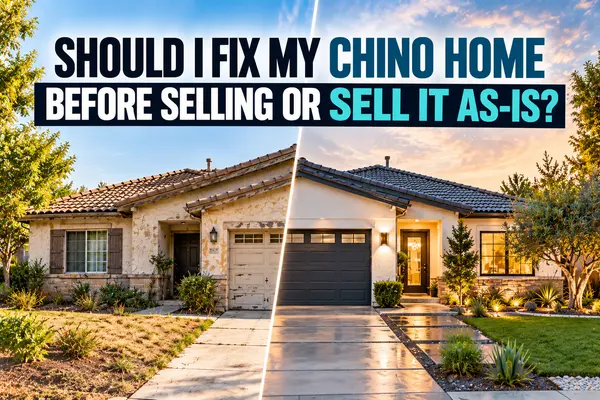
Should I Fix My Chino Home Before Selling or Sell It As-Is?
Should I Fix My Chino Home Before Selling or Sell It As-Is? Your Chino home needs a new roof, the kitchen hasn’t been updated in 25 years, and the flooring has seen better days. Do you really need to spend $50,000 before you can sell? Maybe you’re retiring. Maybe you’re downsizing from a two-story h

Already Bought Your Next House? What to Do if Your Chino Home Hasn’t Sold
Already Bought Your Next House? What to Do if Your Chino Home Hasn’t Sold You bought your next house. You have the keys. You're ready to move forward. But there's one problem: Your old house hasn't sold, and now you're paying for two homes. Two mortgages. Two insurance policies. Two sets of utilitie